Kitchen note
Beginner's Guide to Choosing and Using Grow Lights
Having a room—or even an entire house—with very little natural light can make keeping houseplants healthy a real challenge. Fortunately, grow lights make it possible to build and maintain a thriving indoor plant collection throughout the year. Most plants need at least some amount of light to stay alive because light provides the energy plants use as food. Grow lights are specially designed to imitate natural sunlight, supporting photosynthesis and helping plants produce healthy growth, flowers, and even fruit.
Alric Fenwick
Cook
Bench note
The full story and useful tips are below.
Shelf
Plant kitchen
Having a room—or even an entire house—with very little natural light can make keeping houseplants healthy a real challenge. Fortunately, grow lights make it possible to build and maintain a thriving indoor plant collection throughout the year. Most plants need at least some amount of light to stay alive because light provides the energy plants use as food. Grow lights are specially designed to imitate natural sunlight, supporting photosynthesis and helping plants produce healthy growth, flowers, and even fruit.
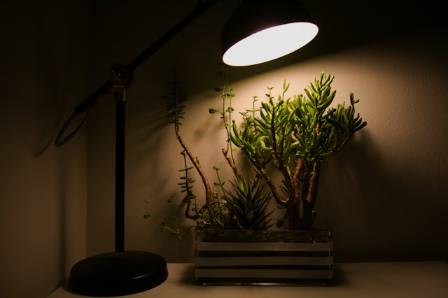
I keep a collection of vintage tins filled with succulents and cacti on top of my refrigerator, and I use grow lights to make sure they receive enough light. Learning how to use them effectively has been quite an experience. Most ordinary lights and bulbs are designed for people, so they typically provide light intended simply to help us see rather than the specific wavelengths plants need for photosynthesis. Plant lights can provide a full spectrum of light or focus on particular parts of the spectrum to encourage different types of plant growth. To make the process easier, here is an overview of the main kinds of grow lights, the different light colors, and the proper way to position and use them.
Grow Bulbs vs. Grow Lights
Grow bulbs are a convenient choice because they can replace ordinary household bulbs in existing lamps and light fixtures. This makes them especially useful when you do not want to purchase an entirely separate lighting setup. However, these bulbs may not always provide a complete light spectrum. Since ordinary household fixtures were not specifically designed around plant requirements, they can also produce uneven illumination or make it difficult to position the light at the ideal distance from the plant.
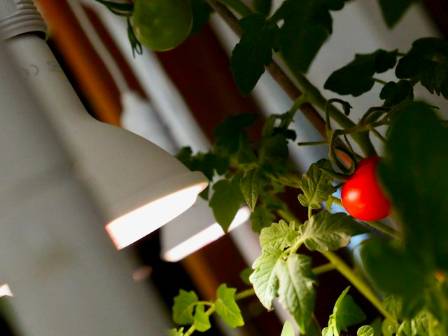
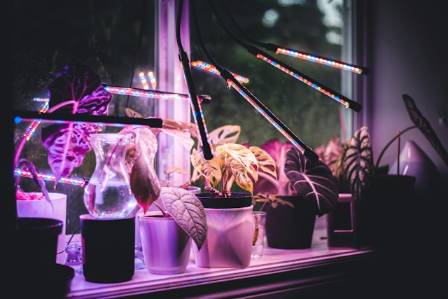
Grow lights are specifically engineered for plants and can therefore provide more consistent illumination across several plants at once. Many models deliver full-spectrum lighting, while others allow you to select or combine particular colors depending on the kind of growth you want to encourage. Grow lights can be mounted on walls or ceilings, inserted directly into plant containers, attached with clamps, installed beneath shelves or cabinets, or, in my situation, attached magnetically to the side of a refrigerator.
Avoid placing a grow bulb in an ordinary ceiling fixture and expecting it to benefit plants below. Unless you have a hanging plant positioned directly underneath the bulb, the distance will generally make the light ineffective. Depending on the type of light, the source usually needs to be positioned within about 6 to 24 inches, or roughly 15 to 60 centimeters, of the plant. The appropriate distance is discussed in more detail below.
What Type of Light Should I Use?
There are three primary types of lighting commonly used for growing plants indoors: incandescent, fluorescent, and LED.
Incandescent bulbs are generally the least suitable option for growing plants. They produce relatively inefficient light and generate a considerable amount of heat, making them less practical for long-term plant lighting.
Fluorescent lights are a familiar choice because they can provide a broad range of light while producing comparatively little heat. They are more energy efficient than incandescent bulbs and are commonly used for indoor plant growing.
LED lighting is a newer option and, in my opinion, the most useful choice. LEDs consume less energy, produce very little heat, and can be designed to provide a spectrum specifically suited to plants. Many LED grow lights also allow you to change between different light colors or combine several wavelengths. My own light can switch between red, blue, and a combination of the two.
What Color Light is Best?
Now for a little science. Visible light covers a range of colors, including red, orange, yellow, green, blue, and violet. Although plants can absorb light across much of this spectrum, the wavelengths toward the red and blue ends are particularly useful for plant growth.
When choosing a grow light, check the product information to determine which parts of the spectrum it provides. A full-spectrum light is generally a good option, while a light combining red and blue wavelengths can also meet many plant needs. Different colors have different effects on plants.
Blue light, along with much of the violet portion of the spectrum, plays an important role in chlorophyll production. It supports healthy foliage development and helps plants grow stronger.
Red light is particularly important for plants that produce flowers. However, excessive exposure to red light can be harmful, so many grow lights combine red and blue wavelengths rather than relying entirely on red. This combination helps provide plants with a more balanced range of light.
Green and yellow wavelengths may provide some limited benefits during seed germination, but they are generally not considered essential for most plants.
How Do I Place and Use the Light?
Whenever possible, position the grow light above the plants. This arrangement most closely resembles natural sunlight and generally provides the most even coverage. However, an overhead setup is not always practical. My own light is mounted on the side of my refrigerator, so it illuminates the plants from both the side and above.
Different types of grow lights require different distances because they produce different amounts of heat. Incandescent lights should be positioned at least 24 inches above the plants. Fluorescent lights produce less heat and can generally be placed around 12 inches away. LED lights can often be positioned much closer, sometimes as little as 6 inches from the plants.
As your plants grow, you will need to reposition the light accordingly. Check your plants regularly and make sure their leaves are not becoming scorched. The distance between the plant and the light also influences how long the light should remain switched on.
The amount of light a plant needs depends on both the season and the species. Flowering plants and vegetables generally require around 12 to 16 hours of light each day. At the same time, plants also need darkness, with at least 8 hours of nighttime being important. During the dark period, plants process and use the energy they accumulated while exposed to light.
Many modern grow lights include built-in timers, which make maintaining a consistent schedule much easier. My own lights switch on at approximately 7 a.m. and remain on for 12 hours each day.
Remember that the farther a plant is from the light source, the less light it receives. For example, an incandescent bulb positioned farther away may need to remain on for a longer period than an LED light placed only 6 inches from the plant.
More from the kitchen

· en
3 Surprising Advantages of Powerful Climbing
Alexandra

· en
Explore Seoul’s Royal Legacy: A Complete Guide to Gyeongbokgung Palace
Victoria Harrington
· en
How Upgrading to an Extra Large Bed Can Revolutionize Your Sleep and Bedroom Decor
Hudson James Ellis

· en
Top 10 Illustration Styles 2026
Zoe Harper

· en
Decoding the Chromatic Science of Fashion Apparel
Ryan Elliot

· en
Guide to Flowers in Impressionism
Arden Knox