Kitchen note
The Painted Bunting: A Colorful Reminder
If there is one thing I have learned from spending decades observing wildlife, it is that nature is always moving and evolving. People often assume that landscapes, animals, and opportunities will remain unchanged, but the natural world is constantly shifting. Change is not unusual in nature; it is one of its most fundamental characteristics.
Theo Walker
Cook
Bench note
The full story and useful tips are below.
Shelf
Plant kitchen
Nature Never Stays the Same
If there is one thing I have learned from spending decades observing wildlife, it is that nature is always moving and evolving. People often assume that landscapes, animals, and opportunities will remain unchanged, but the natural world is constantly shifting. Change is not unusual in nature; it is one of its most fundamental characteristics.
During my 40 years as a wildlife photographer, I have witnessed this endless transformation many times. A location that once offered incredible chances to observe or photograph a certain species can suddenly become different. Conditions change, animals move away, habitats are altered, and those once-incredible moments may disappear forever.
Meeting the “Bunting Lady” of Florida
More than two decades ago, I was fortunate enough to discover an unforgettable birding opportunity in southern Florida through a woman who became known as the “Bunting Lady.” At the time, she operated a daycare center but also had a passion for attracting wild birds. She placed several feeders around her property, creating a gathering place for many beautiful species, including the famous Painted Bunting (Passerina ciris).
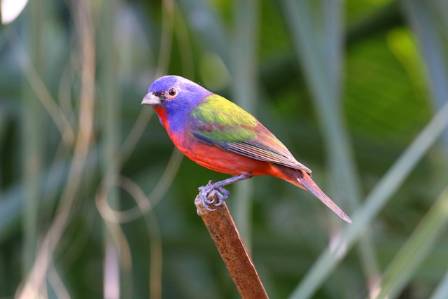
The male Painted Bunting is often considered one of the most beautiful birds in North America. It is sometimes called “Nonpareil,” a French word meaning “without equal.” That name perfectly describes this bird because its brilliant colors truly make it stand apart from other species.
The Stunning Beauty of the Painted Bunting
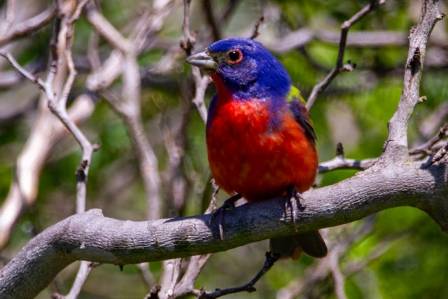
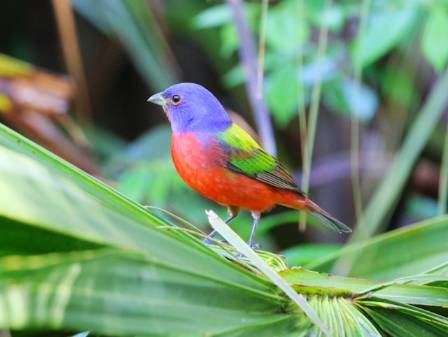
Painted Buntings are similar in size to sparrows. The adult male displays an extraordinary combination of colors, with a deep blue head, bright green back, and vivid red feathers covering the chest, belly, and lower body. Females look completely different, with soft yellow-green feathers and no bold markings, making them much harder to notice.
Seeing a male Painted Bunting for the first time is an unforgettable experience. Its colors are so intense and striking that it almost seems unreal. While many tropical birds in Central and South America display incredible patterns and shades, among North American birds, the Painted Bunting remains one of the most spectacular examples of natural beauty.
A Secretive Bird of Thick Vegetation
Despite their remarkable appearance, Painted Buntings are not easy to observe. They are shy and cautious birds that usually remain hidden among dense plants and shrubs. They often appear only when searching for food or during breeding season.
During breeding periods, males may become easier to spot because they sit on exposed branches while singing to attract females and defend their territory. Their colorful appearance may stand out, but their quiet behavior often keeps them hidden from view.
Migration and Conservation Challenges
Painted Buntings are considered short-distance migrants. The eastern population breeds along coastal areas of northern Florida, Georgia, and parts of the Carolinas before moving south to Florida and the Bahamas during winter.
A western population lives in areas including Louisiana, Texas, and Oklahoma. These birds migrate to Mexico and Central America when temperatures drop. Unfortunately, this group has experienced serious declines because of illegal trapping and the demand for wild birds in the pet trade.
Overall, Painted Bunting numbers have been decreasing, making conservation efforts and habitat protection increasingly important.
A Surprising Return After Twenty Years
While leading a photography tour across Florida recently, I suddenly thought about visiting the place where I had photographed Painted Buntings more than 20 years earlier. Realistically, I believed there was almost no chance that the woman who once attracted these birds would still live there, still maintain her feeders, or still have Painted Buntings visiting her property.
After arriving, I noticed that the house and feeder locations looked different from what I remembered. I slowly drove past, searching for signs of birds or feeding stations. Then I noticed someone outside in the yard.
I stopped, approached the property, and discovered something unbelievable—the Bunting Lady was still there. Not only was she still living at the same place, but she was still feeding Painted Buntings after all these years.
Photographing the Painted Bunting Again
Seeing her again was an incredible surprise. We talked for a while, sharing memories and realizing just how much time had passed since my first visit. I was grateful when she invited me onto her property once more to photograph these extraordinary birds.
We positioned ourselves near one of the feeding areas. Since it was midday, bird activity was slower than it would have been in the early morning, but we did not have to wait long. Soon, three female Painted Buntings appeared near the feeder.
A short time later, a flash of bright red caught my attention deep within the nearby bushes. The male Painted Bunting slowly moved toward the edge of the vegetation, making one final jump onto an open branch. It stopped in a perfect position, giving me the chance to focus and capture the moment.
A Moment That Proved Some Things Can Stay the Same
The male remained on the branch long enough for me to compose a beautiful photograph of this remarkable bird. After so many years, I was amazed that this special place had remained almost unchanged. The Bunting Lady was still welcoming these colorful visitors, and she was still willing to share this magical experience with others.
Perhaps nature does not always change as quickly as we expect. Sometimes, hidden among the constant movement of the natural world, there are rare moments of continuity that remind us how special these connections can be.
More from the kitchen
· en
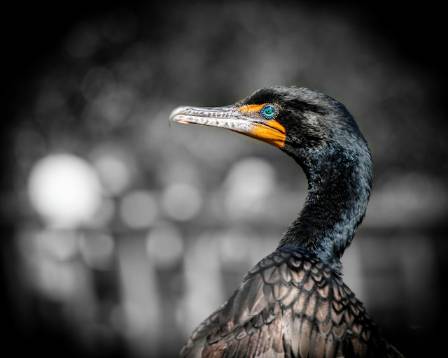
Blue-eyed cormorant or Macquarie Island shag
Mireya Thorn
· en
Nineteen Incredible Butterfly Facts That Will Completely Change How You See Them
Holland Sophia

· en
The Incredible Story and Evolution of the International Space Station
Isla Graham

· en
Top 8 Stunning Terraced Fields in China You Must See
Henry
· en
The Eurasian Nuthatch – Nesting and Territorial Behaviour
Rowan Mercer

· en
5 Ways to Infuse Greenery for a Healthier Lifestyle
Aurora Grace