Kitchen note
What is an Aurora?
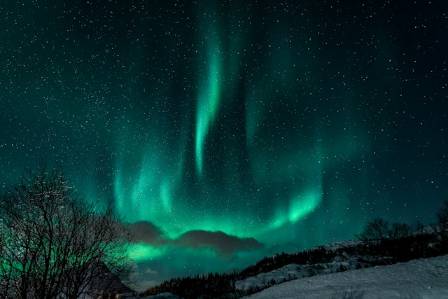
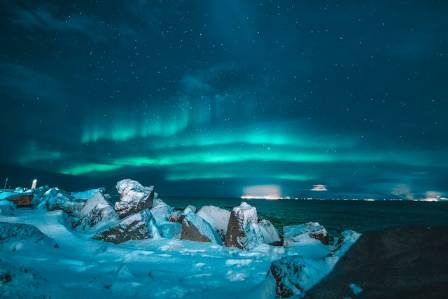
If you ever find yourself close to the North or South Pole, you might have the chance to witness one of nature’s most spectacular displays. Brilliant lights can often appear across the night sky, creating colorful patterns known as auroras. Around the North Pole, this phenomenon is called the aurora borealis, or northern lights. Near the South Pole, it is known as the aurora australis, or southern lights.
Corbin Vale
Cook
Bench note
The full story and useful tips are below.
Shelf
Plant kitchen
If you ever find yourself close to the North or South Pole, you might have the chance to witness one of nature’s most spectacular displays. Brilliant lights can often appear across the night sky, creating colorful patterns known as auroras. Around the North Pole, this phenomenon is called the aurora borealis, or northern lights. Near the South Pole, it is known as the aurora australis, or southern lights.
What Makes This Happen?
Although auroras are most noticeable after dark, their source is actually the sun.
The sun provides Earth with much more than warmth and visible light. It constantly releases energy and streams of tiny particles into space. Fortunately, Earth is surrounded by a magnetic field that protects us from most of this material, so we generally do not notice it.
However, the sun’s activity is not always the same. A steady flow of charged particles known as the solar wind is always moving outward, but the sun can also produce powerful solar storms. One type of solar storm, called a coronal mass ejection, occurs when the sun releases an enormous cloud of electrically charged gas that can move through space at tremendous speeds.
When a solar storm travels toward Earth, some of its energy and particles can follow Earth’s magnetic field lines toward the regions around the North and South Poles. From there, they enter the upper atmosphere.
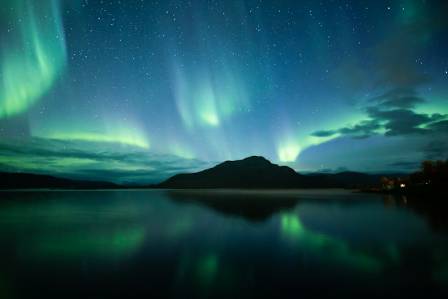
As these particles collide and interact with gases in the atmosphere, they produce the colorful lights we recognize as auroras. Oxygen can create green and red colors, while nitrogen can produce shades of blue and purple.
Do Other Planets Get Auroras?
Absolutely. Earth is not the only planet where auroras occur. Planets that possess both an atmosphere and a magnetic field can potentially produce these glowing displays. Scientists have observed spectacular auroras on planets such as Jupiter and Saturn.
The reddish swirls visible near Saturn’s southern polar region are examples of auroral activity.
Jupiter also has remarkable auroras. Images captured by the NASA Hubble Space Telescope have revealed bright blue auroral lights surrounding the planet.
Watching the Sun
Auroras may be beautiful to observe, but the solar activity responsible for them can sometimes pose serious risks. Energy released during solar storms can interfere with electrical power grids, disrupt communication networks, and damage satellites orbiting Earth. Astronauts aboard the International Space Station must also take precautions because exposure to intense solar activity can be hazardous. Going outside the station for a spacewalk during a solar storm would therefore be extremely unsafe.
The GOES-R series of weather satellites keeps watch on the sun and helps detect solar storms before their effects reach Earth. These satellites do more than observe solar activity. Their instruments also collect information about Earth’s magnetic field and the surrounding space environment, helping scientists monitor conditions in space and provide warnings when solar activity could become dangerous.