
Kitchen note
Nine things you didn’t know about marmots
Marmots are large, ground-dwelling members of the squirrel family and are among the most recognizable animals found in the Alps and other mountain regions. With their round bodies, fluffy fur, and adorable appearance, they have become beloved symbols of alpine landscapes.
Michael Turner
Cook
Bench note
The full story and useful tips are below.
Shelf
Plant kitchen
Marmots are large, ground-dwelling members of the squirrel family and are among the most recognizable animals found in the Alps and other mountain regions. With their round bodies, fluffy fur, and adorable appearance, they have become beloved symbols of alpine landscapes.
Although many people recognize these charming mountain rodents, marmots have a surprisingly interesting history, social structure, and set of survival adaptations.
There Are Fourteen Living Species of Marmots
Today, there are fourteen known living species of marmots, along with four additional species that have been identified from fossil evidence.
The alpine marmot (Marmota marmota) is the only marmot species found in the European Alps. Other marmot species live in mountain regions of North America, including the hoary marmot (Marmota caligata) and the yellow-bellied marmot (Marmota flaviventris).
Not every marmot lives at high elevations. The groundhog (Marmota monax) is a marmot species that prefers lower-elevation habitats rather than mountainous environments.
Alpine Marmots Have Their Own Alarm Language
Marmots are famous for their loud, sharp whistles, which they use to warn others of danger.
Alpine marmots have different alarm calls depending on the type of threat they detect. A single high-pitched whistle usually signals danger from above, such as a hunting eagle. Multiple whistles often indicate a threat approaching from the ground.
Research on some North American marmot species has not shown the same clear connection between specific alarm sounds and different types of predators.
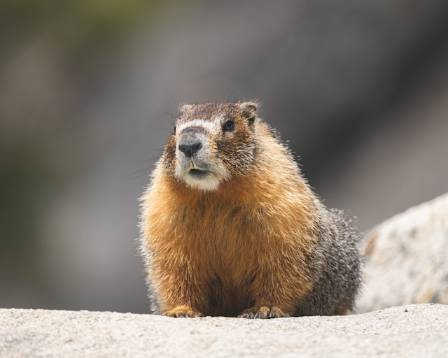
Marmots Live in Family Groups and Form Strong Bonds
Marmots are social animals that usually live in family units with a clear hierarchy. Each family is led by a dominant male and female, and normally only this breeding pair produces offspring each year.
The dominant female helps control reproduction within the group and prevents other members from mating.
Each family has its own underground burrow system. Over many generations, these tunnels can expand into large and complex networks. During winter, all members of the family gather together in the main sleeping chamber, known as the hibernaculum, where they spend the cold months.
Some Marmots Mate Outside the Family Pair
Although marmots are generally considered monogamous, genetic research has revealed that their social system is not always as strict as it appears.
Studies have found that between about 2.2% and 13% of young marmots may have a father other than the dominant male. In some cases, babies within the same litter can even have different fathers.
Marmot Families Live Together in Colonies
Multiple marmot families often form larger colonies. Within these colonies, each family maintains its own territory.
Neighboring groups usually avoid close interaction, and encounters between different families can sometimes become aggressive.
Marmots mark the boundaries of their territory using scent signals from their droppings. These scent markings help identify which areas belong to each family group.
Marmots Spend Most of Their Lives Sleeping
Marmots are famous for their long hibernation periods. They may spend around 200 days each year in a dormant state, losing approximately one-third of their body weight during this time.
Instead of eating throughout winter, they survive by using stored body fat. Their sleep is not completely continuous, however. They experience short periods of activity, which scientists believe may help maintain proper body temperature.
Young marmots face a major challenge during their first year. They must eat enough food during their early months to build sufficient energy reserves before their first winter hibernation.
Whistler Mountain Got Its Name From Marmots
In Canada, marmots are often called “whistlepigs” or “whistlers” because of their loud warning calls.
The famous Canadian ski destination Whistler received its name because of the many marmots living in the area and their distinctive whistles. The mountain was originally known as London Mountain, but as tourism developed, a more appealing name was chosen to attract visitors.
Marmots First Appeared in North America
Marmots have an ancient evolutionary history. After the continents of North America and Eurasia separated around 40 million years ago, rodent populations on the two continents developed independently.
The earliest marmots appeared in North America approximately 15 million years ago. Later, around one million years ago, some marmot populations crossed the Bering Strait into Eurasia, eventually giving rise to the marmot species found there today.
Marmots May Have Helped Humans Find Gold
Marmots have even played a role in ancient stories about gold discovery.
Around 2,500 years ago, the Greek historian Herodotus described large “golden ants” that were said to be larger than foxes and connected with gold collection in the ancient Persian Empire.
For centuries, this story was considered fictional. However, research in the 1990s suggested that Herodotus may actually have been describing golden marmots living in what is now Pakistan.
The ancient Persian word for marmot translated roughly as “mountain ant.” These marmots dug burrows in sandy soils containing gold particles, and small amounts of gold-bearing material became attached to their fur. Historians now believe local people may have collected gold from the sand brought to the surface by these burrowing animals.

More from the kitchen

· en
Japanese Ceramic Vases: Symbolism, Heritage, and Spiritual Resonance
Genevieve

· en
5 Ways to Infuse Greenery for a Healthier Lifestyle
Aurora Grace

· en
How to Paint a Watercolor Butterfly
Alex Rowan

· en
Glacial Landforms and Rock Types
Nathaniel Sterling

· en
Understanding the Essence of Slow Living
Liam Jackson

· en
What are the Safest Door Locks for a Home?
Ryan Mitchell